Bookmark and Share


IRS Tax Credits available


Made In USA

Search FAQs Here for Answers

Browse Categories

Radiant Barriers 101 - Increase Your Understanding

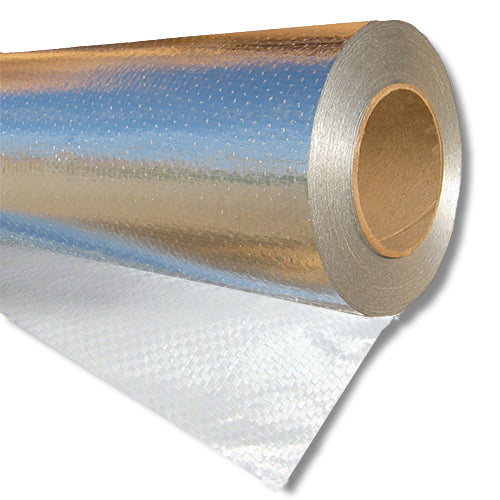
Radiant barrier foil insulation is a reflective insulation system that offers a permanent way to reduce energy costs. Radiant barrier foil insulation systems BLOCK radiant heat energy instead of absorbing it like fiberglass insulation.  A pure aluminum radiant barrier reflective foil insulation is unaffected by humidity and will continue to perform at a consistent level no matter how humid it may be. A radiant barrier foil insulation system is a layer of foil facing an airspace and is installed in the envelope of a building.

In order to fully understand how radiant barriers work and how they can benefit you, the following information has been comprised to provide a foundation for your new radiant barrier knowledge and understanding.

How Heat is Transferred

Heat is transferred from one source to another via three methods of transfer: conduction, convection, and radiation.

Conductive:  the transfer of heat flowing through a substance (molecular motion) or to another touching substance. If you touch a pot on the stove, the heat is transferred from the pot to your hand via conductive heat transfer.

Convective:  the transfer of heat in fluids, such as rising heated air, steam, and moisture. If you put your hand above a boiling pot, you will feel heat rising from the pot in the form of steam. This transfer of heat from the pot upwards is via convective heat transfer.  Convective heat transfer results in warmer air rising and cooler air settling creating a convection loop termed free convection.  A Convection loop can also be generated mechanically with the aid of fan or wind and is then called forced convection.

Radiant: the transfer of heat via infrared radiation rays that are invisible to the naked eye and unaffected by air currents.  If you step outside on a windy sunny day, you will feel the sun's heat rays on your face. This transfer of heat from a heated source across an air space to a colder surface is via radiant heat transfer.  All materials radiate radiant heat in ranges from 0% to 100%.

Common examples of radiant heat transfer:

  • Skin warming up when outside on a sunny day via the radiant heat from the sun regardless of the ambient temperature.

  • Roof shingles heated via the radiant heat from the sun.

  • Heat radiating from a light bulb.

Conventional Insulation

Most people are familiar with traditional insulating materials such as fiberglass, cellulose, Styrofoam, and rock wool.   These products absorb or slow down convective and conductive heat transfers to insulate.  These types of insulation do not BLOCK heat - only slow it down.  Therefore, after a period of time, 100% of the heat absorbed would eventually transfer through the insulation.  The rate in which this heat eventually transfers through an insulation material is the material's R-Value.

  • Fiberglass and blown-in cellulose insulation rely on air spaces within the material to decrease the conductivity of heat.  They also reduce convective heat flows by trapping heating air flows and thereby restricting air circulation.

  • Foam insulations work similarly to fiberglass and blown-in insulation.  Some foam insulations use hydrochlorofluorocarbons (HCF) to absorb and slow down the transfer of heat via conductive and convective measures.  However, the United States has scheduled phasing out the manufacturing and importing of all HCFs over the next 23 years.  HCF's, such as those contained in some foam insulation products, are considered very potent greenhouse gases.

How Radiant Barriers Work

A radiant barrier reflects/BLOCKS radiant heat energy instead of trying to absorb it.   A radiant barrier also REDUCES convective heat transfer by acting as a physical blockade against convective air flow.

How does a radiant barrier reflect/BLOCK radiant heat?

The aluminum found in radiant barriers has two properties that enable it to reflect/BLOCK radiant heat when at least one air space is provided on one side:

  1. Reflectivity = The natural reflectivity property of aluminum facing a heat source across an air space allows the aluminum to REFLECT radiant heat back to the direction from which it came.

  2. Emissivity = All materials have emissivity's ranging from 0% to 100%.  The lower the emittance percentage of a material, the lower the amount of radiant heat radiated from its surface.  The naturally low emissivity property of aluminum facing an air space results in very low emittance of heat from itself; it does not radiate much of its own heat from itself.    This naturally low emissivity property makes aluminum ideal for use in radiant barriers.


Example of reflectivity property in common every day uses.  This aluminum keeps the chocolate from getting too warm and melting.

A Radiant barrier REFLECTs radiant heat that strikes its surface across an air space from a heat source and conversely, it EMITs very little radiant heat from its surface across an air space opposite a heat source.

Why Radiant Barriers REQUIRE An Air Space

No matter how you plan to install a radiant barrier, it MUST have at least one air space of at least 3/4 of an inch on either side to be effective at BLOCKING radiant heat.  It does NOT matter which side of the radiant barrier the air space is located.  The purpose of the air space is to prevent conductive heat transfer.

If a radiant barrier does not have at least ONE air space on either side of it, heat will conduct from the surface touching the radiant barrier, through the barrier, and then transfer to the next surface touching the radiant barrier on the opposite side therefore, giving you no protection against the heat you intend to block.

Therefore, as long as the air space requirement is achieved, a radiant barrier will be effective at BLOCKING radiant heat regardless of your application, i.e. interior/exterior walls, siding, roofing and attic locations, etc.

What Happens When No Air Space Exists

Because a radiant barrier requires an air space on at least one side of itself to be able to BLOCK radiant heat, a radiant barrier CANNOT be installed directly underneath roofing materials where no air space exists.

For example, if you install a radiant barrier on top of roof decking between the felt paper and asphalt shingles, it will NOT provide any benefits as the radiant heat would be transferred through the shingles, through the felt to the radiant barrier, and through the roof decking into the attic space (see image below).

A radiant barrier can be effective with an asphalt shingle roof ONLY when installed inside the attic either to the underside of the roof decking or to the underside of the roof rafters.  In these attic space applications, there is an air space below the radiant barrier.  It is the existence of a single air space that eliminates, almost entirely, the pass-through of radiant heat.

Our RadiantGUARD® radiant barriers REFLECT 97% of the radiant heat that strike their surface across and air space and conversely only EMIT 3% of the radiant heat from their surface facing an air space.

Everyday Example of Low Emissivity Across an Air Space

The help you understand the more difficult concept of emissivity, imagine of a hot baked potato wrapped in aluminum foil.  If you hold your hand close to the wrapped potato (not touching it), you would feel very little radiant heat coming off the aluminum because aluminum doesn't “emit” much heat across an air space (aluminum has a low emissivity factor).  If you were then to touch the aluminum wrapped baked potato, you would feel a great deal of heat because the aluminum would then be conducting heat from the potato, through the aluminum, to your hand.  Because you have lost the air space, the heat would contact (conduct) to your hand.

A radiant barrier is ONLY effective when at least a 3/4" air space is provided on either side of itself regardless of the location of the heat source.   If the air space is on the side of the heat source, the REFLECTIVITY property works to REFLECT the radiant heat.  If the air space is on the opposite side of the heat source, the low EMISSIVITY property works to reduce the amount of radiant heat that EMITs from its surface.

Blocking Radiant Heat Transfers in a Home or Building

All building surfaces include roofs, ceilings, and even conventional fiberglass and blown-in insulation radiate heat in varying degrees.  Radiant heat from the sun strikes the outer surfaces of roofs and walls and is absorbed causing building surfaces to heat up.  This absorbed heat moves through the material (via conduction) to the opposite side and is then radiated from itself into attics and living spaces increasing the temperatures inside the building.

Installing a radiant barrier is a MUST to combat the major form of heat transfer (radiant)  that is currently not being controlled by your conventional insulation.

What Classifies as a Radiant Barrier

Per the Department of Energy (DOE), a product classified as a "radiant barrier" MUST have a low emittance of 10% or less and a high reflectance of 90% or more.

RadiantGUARD® radiant barriers have an emittance of only 3% and a reflectance of 97%; considerable better than the DOE's radiant barrier minimum classification requirements.  For more information, visit the Department of Energy website.

How RadiantGUARD® Radiant Barriers Benefit You

RadiantGUARD® radiant barriers reflect/BLOCK radiant heat; not just absorb or slow it down like other forms of insulation.

RadiantGUARD® radiant barriers are unaffected by humidity or ambient temperatures, unlike other forms of insulation, and therefore, perform at a consistent level at all times.

RadiantGUARD® radiant barriers reflect/BLOCK 97% of the radiant heat transfer and when installed in an attic space, they can result in a reduction of attic temperature below the radiant barrier of up to 30 degrees.  Lowering the temperatures above living space ceilings provides a significant benefit by reducing air conditioning loads and energy usage.  Our radiant barriers can:

  • Reduce heat transfer from attic to living spaces by 16-42%,

  • Extend the life of air conditioning unit,

  • Increase the comfort level of a home or building, and

  • Reduce heat and cooling bills up to 17%.

RadiantGUARD® radiant barriers are safe and easy to install:

  • No breathing apparatus required

  • Non-toxic / non-carcinogenic

  • Clean and lightweight; easy to handle

  • Installation requires no special tools or clothing

  • Don't promote the growth of fungi or bacteria

  • Provides no nest support for rodent or insect pests

  • Class A / Class 1 Fire Rating

  • Meets fire and smoke safety requirements of most federal, state and local building codes

  • Require no maintenance

  • Do not shrink

RadiantGUARD® Testing and Approvals:

  • United States Testing Company

  • Tennessee Valley Authority

  • Tennessee Technological University

  • State of California Quality Standards

  • Oak Ridge National Laboratory

  • Metro Dade County

  • Texas A&M University

HACKER SAFE certified sites prevent over 99.9% of hacker crime.
Shopping Cart
Your cart is empty.

Enter Zip Code for Shipping Rates