When installing a radiant barrier over the attic floor, over existing insulation in place or not, you MUST use a perforated radiant barrier. This is because moisture-laden air generated in your home from breathing, washing clothes, bathing, running the dishwasher, etc travels upwards and must be able to pass through the radiant barrier to escape your attic. If a solid radiant barrier were used in this location, it would trap the moisture in the air and condensate resulting in water droplets that would drip onto your insulation/attic floor and rafters causing damage.
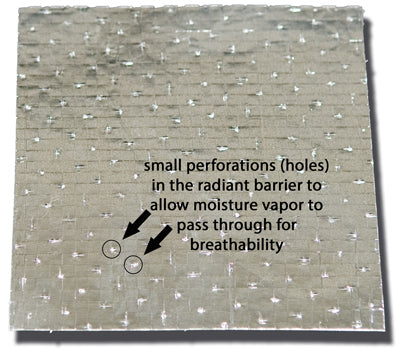
Our RadiantGUARD® radiant barrier comes in both a perforated (breathable) and solid (vapor barrier) version. Our reflective bubble insulation products are only available in a solid (vapor barrier) version.
Breathable (B) vs. Solid Vapor Barrier (VB)
As a general rule of thumb, a breathable perforated radiant barrier should be used when the product is installed in an area that has air movement such as in an attic or as a house wrap on the exterior side.
A solid vapor barrier product (radiant barrier or reflective bubble insulation) is typically used in the northern climate zones on the interior wall side. Another use for solid vapor barriers is when installed in stucco structures or in high hydrostatic pressure areas along the southern US coast.
For most all steel / metal buildings, a reflective bubble insulation vapor barrier is recommended to help control condensation which is a typical issue with these structures.
If you are unsure about what version to use, we highly recommend you contact your local building code department for advice.